01
Free: 60-minute call and Blueprint.
A working session on your business, then a clear plan of what we would build and in what order, written down for you to keep. No cost, no obligation.
Manufacturing
In furniture and wood, board and timber are most of your cost, so the win is seeing true yield by product and machine, catching the overbilling buried in your board and hardware invoices, and running certification and grade compliance to a calendar, all governed and tied to rupees before you add a single new tool.
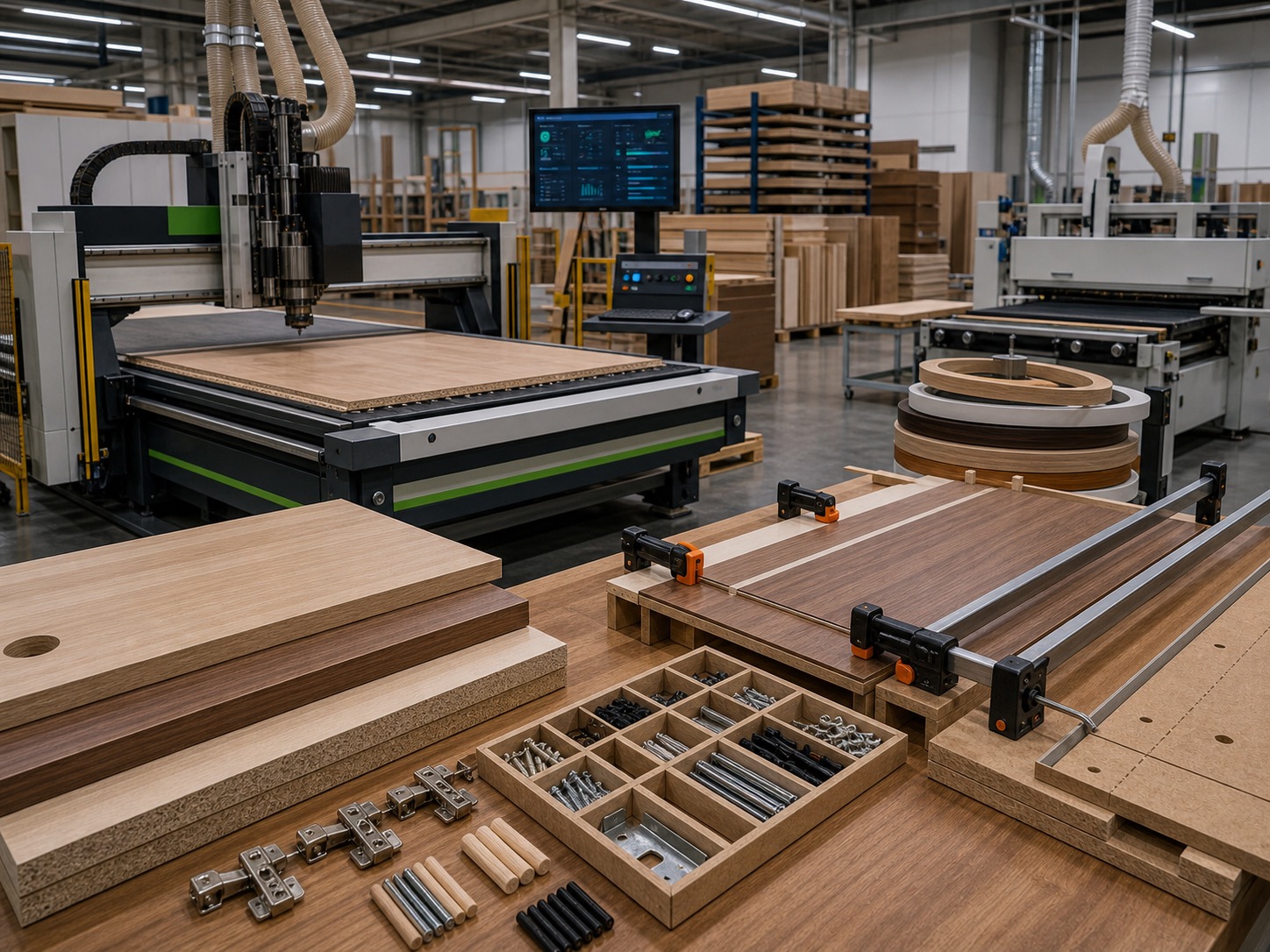
The art of the possible
The art of the possible. None of the wins here are "AI designs your furniture" or "AI runs your press." They are: your true board and timber yield visible by product and machine instead of guessed at month-end, so the offcut and reject that is most of your cost finally surfaces; every board, veneer, resin, laminate and hardware bill checked against the rate and quantity you actually agreed, so the overbilling hidden in hundreds of GRNs and invoices is caught before payment; your ISI / QCO certification, your board grade and emission compliance and your timber-source trail run to a calendar with a named owner, so a deadline or an inspection never costs you a shelf or a contract; the grade and brand integrity of every board you ship protected against substitution and counterfeit; your designers, dealers and carpenters worked the way building-materials brands work them; your project and fit-out margin tracked so a job does not slip unnoticed; and your true cash, stock and margin-by-product visible every morning instead of four weeks late.
The operating reality
One name covers four different businesses sharing a raw material: a board-cutting modular plant with a designer and dealer channel, a piece-rate solid-wood and export atelier, a grade-and-glue panel processor, and a project-bid fit-out firm. In every one of them board or timber is most of the cost, yield and the supplier bill are the biggest controllable money, and the owner runs it from disconnected records while the new Furniture quality-control order and board grade rules raise the stakes on compliance.
By segment
The same industry runs differently across its segments. Here is the operating reality of each, and the builds we would rank first, with why.
Cut engineered board on panel saws and CNC nesting routers, edge-band and assemble modular kitchens, wardrobes and office systems, sold through a dealer and interior-designer channel; panel cutting yield off every board, the board, laminate and hardware bill, and that designer-and-dealer front office are the spine.
The cut-to-edge-band-to-assembly flow is where board becomes parts or becomes offcut and scrap; tracking cutting yield, reject and rework by product and machine is the biggest controllable money in the plant.
See what we buildBoard yield slipping or reject creeping on one wardrobe or cabinet line stays invisible until month-end; an early flag when a figure drifts outside its normal band catches it while it is still cheap.
See what we buildTrue margin per product, once board cost, yield loss, hardware and laminate are netted in, is an argument here rather than a number; one screen makes the loss-making cabinet line visible.
See what we buildEngineered board, laminate, hardware and edge-band are most of the cost; checking each bill against the agreed rate, grade and quantity catches off-grade board paid at on-grade rate and the overbilling hidden across GRNs.
See what we buildBecause board and hardware dominate the cost, the recoverable slice across rate drift, short-supply and silent below-costed yield is large in absolute rupees and traces to the plant's own purchase and cutting records.
See what we buildCutting-lists, board and hardware invoices and GRNs arrive on paper and in PDFs and never cleanly reach a system, starving the yield and procurement checks of the data they need.
See what we buildThe same board invoice is re-keyed by three people and a GRN never ties to its order; capturing each document once and routing it feeds procurement and the data layer without the re-keying queue.
See what we buildDealer credit limits, discounts and purchase rates are signed by phone and stall when the boss travels; a routed rule with the vendor and dealer context attached keeps the routine moving and the exception recorded.
See what we buildConvert timber into solid-wood furniture, doors and made-to-order joinery largely by piece-rate artisan job-work, with a large share exporting from the Jodhpur and Saharanpur clusters; the order-to-ship workflow, the artisan piece-rate record, timber yield and the export-documentation file are the spine.
The whole business is order-to-ship piece-rate craft; tying timber issued to good output, reconciling artisan piece-rate to work done and clustering finishing rework is where the order ships late, short or with a polished piece reworked twice.
See what we buildTimber conversion yield drifting, finishing rework rising on one artisan or finish, or an export order slipping its dispatch date are caught at month-end if at all; an early signal turns the post-mortem into a same-week warning.
See what we buildCash, work-in-progress, margin by order and export realisation after freight and drawback are what an exporter flies blind on between closes; one current screen replaces last month's ghost.
See what we buildTimber is seasonal and price-volatile and finishing material and hardware are bought against drifting rates; checking each bill against the agreed rate and quantity catches short-supply and overbilling on the largest cost line.
See what we buildTimber conversion loss below the costed norm, finishing rework cost and supplier-bill leakage are recoverable from the unit's own job-cards and invoices, and the piece-rate trail makes the number provable.
See what we buildHand-written job-cards, piece-rate slips and the export-document pack are exactly the messy inputs that never reach a system; reading them into clean rows is the quiet prerequisite for yield, leak and export tracking.
See what we buildFor an exporter a missing or wrong invoice, packing list, bill of lading or certificate holds a container; assembling and checking the export pack once removes the last-minute scramble.
See what we buildExport pricing and a customer sample are signed off informally and lost; a routed rule with the order's costing attached records who priced the made-to-order piece and at what margin.
See what we buildPress veneer, chip or fibre with resin into plywood, MDF, particle board and decorative laminate at industrial scale, sold through a dealer channel; this is a grade-and-glue continuous process where buying veneer and resin well, protecting grade and brand integrity, and meeting board BIS and emission standards are the game.
The press line is where margin is made: press-to-good yield, trim and reject, and a grade-and-glue integrity log so a grade complaint traces to its press batch and no lower grade ever ships against a higher-grade line.
See what we buildMargin by grade thinning as a dealer scheme over-runs, or a board test drifting toward an emission limit, is expensive to discover late; thresholds tuned per grade and press flag the drift before a shipment or an audit.
See what we buildFor a panel processor margin by grade after schemes is the business, yet it hides inside a giant turnover number; one screen nets veneer and resin cost, yield and scheme give-away into true margin per grade.
See what we buildVeneer, chip, fibre and the resin and glue line are the single largest cost; checking each bill against the agreed grade, rate and quantity is the most provable money, and the same grade-substitution risk that bites at sale bites at buying.
See what we buildResin and freight billed above the rate card and dealer-scheme over-claims are large in absolute rupees on a high-volume plant and recover line by line from the processor's own invoices and scheme claims.
See what we buildPrinted board grade and emission test reports, veneer and resin invoices and GRNs sit on paper; reading them into structured rows feeds the grade register, the procurement check and the margin view.
See what we buildBoard test certificates, GRNs and grade documents must be filed against the right lot and retrievable in minutes when a BIS inspection or a buyer audit lands; capturing them at the door builds that trail as a by-product.
See what we buildAn unapproved grade concession on a shipment is a direct loss and a brand risk; routing every concession to a named approver with the margin attached stops it slipping through unrecorded.
See what we buildBid and deliver project work, institutional and office furniture contracts, hospitality and retail fit-outs and interiors made to a drawing, a bill of quantities and a deadline; quoting off the takeoff leads, and project work-in-progress, site-progress and variation capture are the operating spine.
Each job is a project, not a repeat run; tracking work-in-progress, milestone and site progress and capturing the variation as it happens is where margin lives or quietly slips on the floor and at the site.
See what we buildA project crossing its budget or a client's payment slowing is found when it is already a loss; an early flag on project cost and margin drift catches the bleeding job while there is still time on the schedule.
See what we buildLive project margin, work-in-progress and retention and receivables aging are the numbers a fit-out owner most needs and least has; one screen replaces the spreadsheet rebuilt by hand after the job is done.
See what we buildProject material and sub-contract spend is bought fresh per job against a quoted budget; checking each bill against the agreed rate protects the thin margin the under-priced bid already squeezed.
See what we buildThe under-costed quote, the site variation never billed and the procurement drift are the recoverable project margin, and each traces line by line to the job's own costing and bills.
See what we buildDrawings and bills of quantities arrive as PDFs and scans and feed the quote and the project record by hand; reading them into structured rows speeds the takeoff and the costing the bid depends on.
See what we buildDrawings, bills of quantities, GRNs and snag lists are paper-heavy and buried in inboxes; capturing and filing each against its project keeps the costing, the site record and the compliance pack in one retrievable place.
See what we buildAn uncaptured site variation is unbilled margin gone; routing every quote, variation and payment to a named approver with the project's margin to date attached turns the variation into billed work.
See what we buildThe whole picture
Front office
How the business is found, sells, and is reached.
Back office
How the work actually gets done, day to day.
Talk to your data
One trusted picture you can read and ask questions of.
How an engagement works
01
A working session on your business, then a clear plan of what we would build and in what order, written down for you to keep. No cost, no obligation.
02
Go deeper on one area, or have us build the software, app or data layer. Fixed price. A focused build ships in weeks.
03
We keep it running and watch over it, as much or as little as you want.
Related industries
A free 60-minute call. No cost, no obligation, just a clear read on what is worth building.